

In January 2024, an employee at engineering firm Arup joined a video call with who appeared to be the company’s CFO and several colleagues. Every face and voice on the call was an AI-generated deepfake. By the end of the call, the employee had authorized 15 wire transfers totaling $25.6 million to accounts in Hong Kong (CNN). No malware. No hacked firewall. Just a convincing enough impersonation to walk through the front door.
That’s the threat model security teams are now up against, and it’s exactly what zero trust architecture is built to contain. This guide explains what zero trust is, why AI-generated threats make it more relevant than ever, how it actually works, and which vendors, including Cloudflare, Tailscale, Zscaler, and Okta, can help you get there.
What Is Zero Trust Architecture?
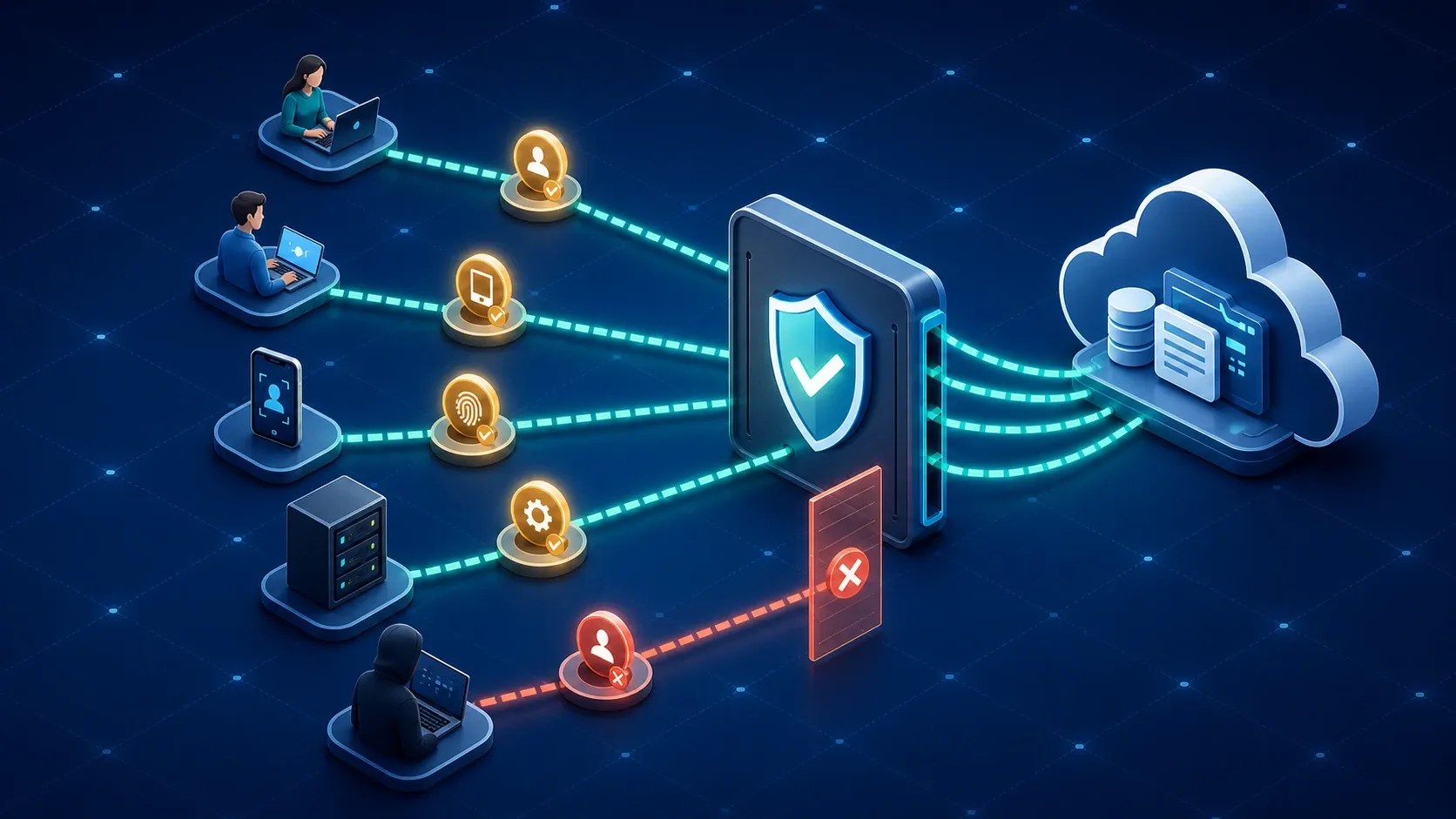
Zero trust architecture (ZTA) is a security model built on one core assumption: never trust, always verify. Instead of granting broad access once someone is “inside” the network, every user, device, and application must continuously prove it should be trusted for each specific request.
The concept was formalized by the U.S. National Institute of Standards and Technology in NIST Special Publication 800-207, which defines zero trust as a collection of concepts and ideas designed to minimize uncertainty in enforcing accurate, least-privilege, per-request access decisions. In plain terms: no user, device, or network segment is trusted by default, not even ones already inside the corporate network.
This is a fundamental break from the old model.
The Old Model: Trust the Perimeter
Traditional network security worked like a castle with a moat. Build a strong perimeter (firewalls, VPNs), and anything inside the walls is implicitly trusted. Once a user authenticated to the VPN, they typically had broad access to internal systems.
That model made sense when employees worked from one office, on company hardware, connecting to on-premises servers. It doesn’t hold up anymore:
- Work is distributed. Employees connect from home networks, coffee shops, and personal devices.
- Data lives in the cloud. Applications and data increasingly sit in SaaS platforms and cloud infrastructure outside any physical perimeter.
- Credentials get stolen constantly. Once an attacker has a valid login, a perimeter-based model treats them as fully trusted.
- One compromised account can move freely. Without internal segmentation, a single phished employee can become a path to the entire network.
Zero trust replaces “trust once, access everything” with “verify continuously, access only what’s needed.”
Why AI Threats Make Zero Trust Non-Negotiable
The perimeter model was already showing cracks. Generative AI has turned those cracks into open doors, because AI doesn’t just automate attacks, it makes them personalized, fast, and far more convincing than anything a human attacker could produce at scale.

AI has industrialized phishing
Phishing used to rely on generic, often clumsy templates. Large language models changed that. Security vendor Cofense reported that AI-powered phishing accelerated to one malicious email attack every 19 seconds in 2025, more than double the pace of one every 42 seconds in 2024 (Cofense). Attackers now use AI to write flawless, personalized, context-aware messages that mimic a real colleague’s tone, reference real projects, and adapt in real time to a target’s replies.
Deepfakes now defeat “does this look/sound right?”
For decades, employees were trained to trust a familiar face or voice. That assumption no longer holds. The Arup case above cost $25 million from a single deepfake video call. Identity verification firm Sumsub’s Identity Fraud Report 2025-2026 found that deepfakes are now among the most common first-party fraud schemes globally, with the most sophisticated fraud attempts up 180% year over year (Sumsub).
The takeaway for security teams
AI-generated attacks are specifically designed to defeat human judgment and identity assumptions, exactly the assumptions a perimeter-based network was built on. Zero trust doesn’t try to out-guess whether a request “looks legitimate.” It assumes every request could be hostile and verifies it anyway, through mechanisms an AI-generated voice or video can’t fake:
- Device posture checks catch a request coming from an unmanaged or non-compliant device, regardless of how convincing the person on the call sounded.
- Continuous, contextual authentication flags a login from an unexpected location or a session that doesn’t match established behavior patterns.
- Least-privilege access means that even if one identity is compromised (phished, deepfaked, or otherwise), the blast radius is limited to what that identity was scoped to touch, not the entire network.
- Out-of-band approval workflows for high-risk actions (like wire transfers) require verification through a channel a video call or spoofed email cannot reach.
Zero trust doesn’t eliminate the risk of AI-powered social engineering, but it removes the single point of failure that these attacks depend on: broad implicit trust once someone is “in.”
The Five Pillars of Zero Trust
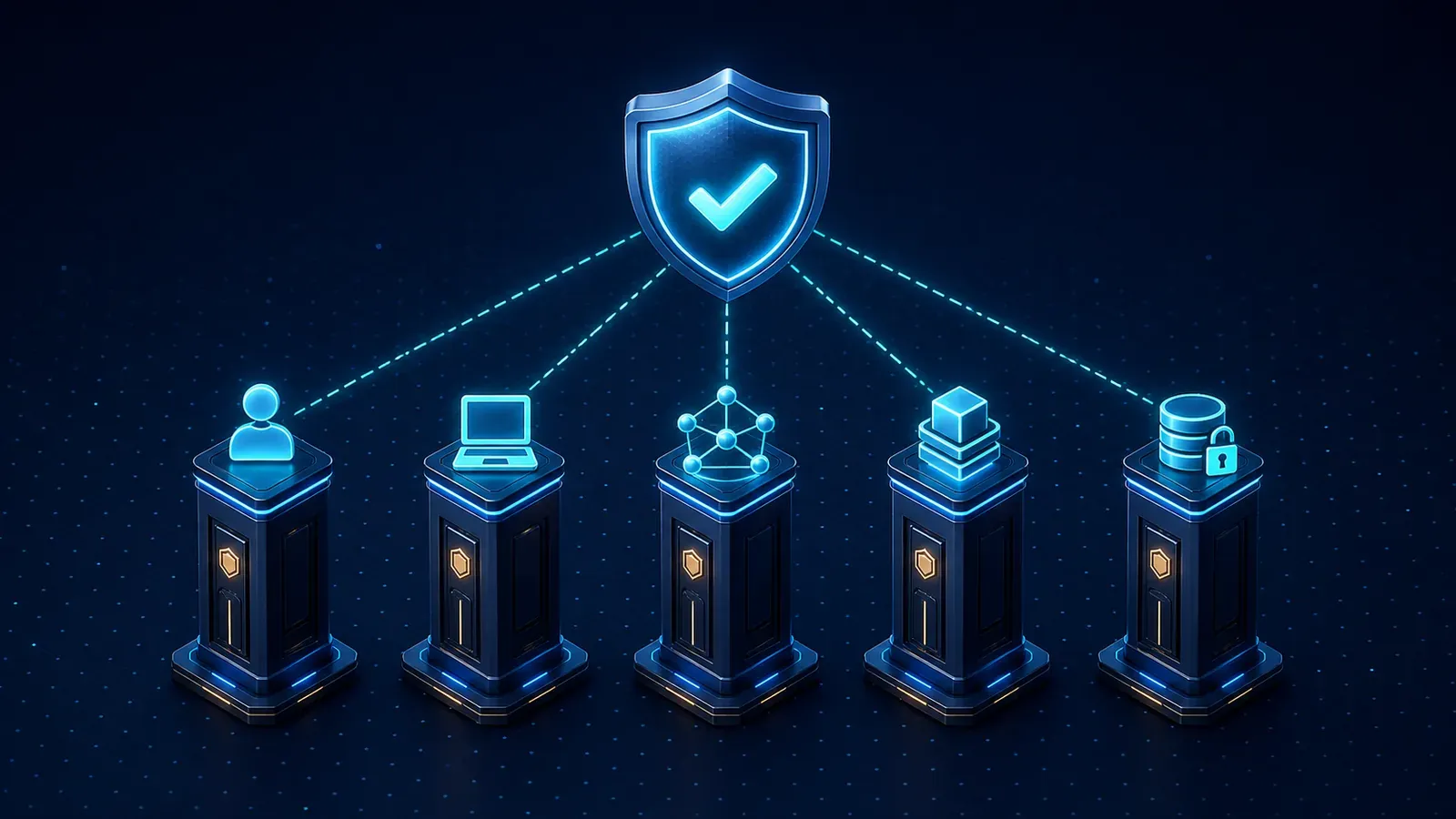
The U.S. Cybersecurity and Infrastructure Security Agency (CISA) publishes the Zero Trust Maturity Model, which breaks zero trust into five foundational pillars, supported by three cross-cutting capabilities.
| Pillar | Focus |
|---|---|
| Identity | Continuously verify who is making the request, not just at login |
| Devices | Confirm the device is managed, patched, and compliant before granting access |
| Networks | Segment traffic so a breach in one area can’t spread laterally |
| Applications & Workloads | Apply granular, per-application access controls, on-prem and in the cloud |
| Data | Classify and protect data itself, with encryption and access policies tied to sensitivity |
The three cross-cutting capabilities, Visibility & Analytics, Automation & Orchestration, and Governance, tie the pillars together so policies are enforced consistently and anomalies are caught in real time rather than discovered after the fact.
How Zero Trust Works in Practice
A simplified zero trust access flow looks like this:
- A user or device requests access to an application, file, or system.
- The identity is verified through multi-factor authentication (MFA), not just a password.
- The device is checked for compliance: is it managed, encrypted, running approved software, free of known vulnerabilities?
- Context is evaluated: location, time of day, network, behavior compared to the user’s normal pattern.
- A policy engine makes a per-request decision, granting the minimum access needed for that specific task, for a limited session.
- The session is continuously monitored. If risk signals change mid-session (a new location appears, unusual data access begins), access can be revoked instantly, not just at the next login.
Notice what’s missing: there’s no step where “already inside the network” grants automatic trust. Every request goes through this loop.

Zero Trust Vendors and Tools to Know
Zero trust is a strategy, not a single product, but a handful of vendors have built the tooling that makes it practical to implement. Here’s how the major players position themselves:
Cloudflare Zero Trust (Cloudflare One)
Cloudflare’s SASE platform bundles Zero Trust Access, a Secure Web Gateway, Cloudflare Tunnel, Data Loss Prevention, and Remote Browser Isolation into one control plane, delivered from Cloudflare’s global network in 300+ cities (Cloudflare). It’s identity-first, requires no traditional VPN, and now extends zero trust access controls to AI agents and MCP servers, not just human users, which matters as businesses adopt more AI tooling internally. Cloudflare is a strong fit for businesses that already use Cloudflare for DNS or CDN and want networking and security unified under one vendor.
Tailscale
Tailscale builds a zero-config mesh VPN on top of the WireGuard protocol. Instead of routing traffic through a central VPN server, it creates direct, end-to-end encrypted connections between devices, authenticated through your existing identity provider (Okta, Google Workspace, Microsoft Entra ID) and governed by access control lists (Tailscale). It’s notably fast to deploy, making it a popular choice for small and mid-sized businesses and engineering teams that want zero trust network access without an enterprise-grade rollout project.
Zscaler Zero Trust Exchange
Zscaler is one of the longest-standing names in this space and is recognized as a Leader in Gartner’s Security Service Edge Magic Quadrant. Its Zero Trust Exchange routes traffic through a cloud-native security stack rather than backhauling it through a data center, which suits large, distributed enterprises with complex compliance requirements.
Okta and Microsoft Entra ID
Zero trust starts with identity, and Okta and Microsoft Entra ID are the two dominant identity providers underpinning most zero trust deployments. Okta functions well as a standalone identity layer across a mixed technology stack; Microsoft Entra ID (with Conditional Access as its policy engine) is typically the most efficient choice for organizations already standardized on Microsoft 365 and Azure.
Choosing a starting point
| If you are… | Consider starting with… |
|---|---|
| A small business replacing an aging VPN | Tailscale |
| Already using Cloudflare for DNS/CDN | Cloudflare Zero Trust |
| A large enterprise with complex compliance needs | Zscaler Zero Trust Exchange |
| Standardized on Microsoft 365 | Microsoft Entra ID + Conditional Access |
| Using a mixed identity stack | Okta |
Most mature deployments end up combining an identity provider (Okta, Entra ID) with a network/access layer (Cloudflare, Tailscale, or Zscaler) rather than relying on a single vendor for everything.

The Business Case: What Skipping Zero Trust Actually Costs
Zero trust is sometimes framed as a compliance checkbox, but the financial case is direct. IBM’s Cost of a Data Breach research found that organizations with a mature zero trust deployment had an average breach cost of $3.28 million, compared to $5.04 million for organizations that hadn’t started down that path, a 42% difference (IBM). Early-stage adopters still saw meaningful savings over non-adopters, but the gap widens significantly with maturity.
The market has already priced this in. Gartner has forecast that at least 70% of new remote access deployments will rely on zero trust network access (ZTNA) instead of VPNs, up from under 10% in 2021 (reported via Data Center Knowledge). VPN-based remote access is becoming the exception, not the default.
Getting Started: A Practical Roadmap for SMBs
Zero trust doesn’t have to mean a multi-year enterprise overhaul. For small and mid-sized businesses, a phased approach works better than an all-at-once rebuild:
- Inventory identities and devices. You can’t enforce least-privilege access to systems you haven’t mapped. Start with a full list of users, service accounts, and the devices that connect to your network.
- Enforce MFA everywhere. This is the single highest-leverage step and directly blunts credential-phishing attacks, AI-generated or not.
- Review and tighten access permissions. Most organizations carry years of accumulated, overly broad access. Move toward least privilege: each identity gets only what it needs for its role.
- Replace VPN access with ZTNA. Tools like Tailscale or Cloudflare Access let you retire flat, all-or-nothing VPN access in favor of per-application, per-session access.
- Add device posture checks. Ensure only managed, compliant devices can reach sensitive systems.
- Monitor continuously. Visibility into access patterns is what allows you to catch a compromised account behaving abnormally, rather than discovering it after data has already left.
- Extend policies to AI tools and agents. As your team adopts AI copilots, agents, and MCP-connected tools, they need identity and access governance too, not a blanket exemption because they’re “just software.”
How RAD Digital Solutions Can Help
Moving from a perimeter-based network to a zero trust model touches identity management, device policy, network architecture, and staff workflows all at once, which is exactly where a structured IT partner earns its keep. Our team helps businesses:
- Assess current network and identity architecture against the CISA Zero Trust Maturity Model
- Design a phased rollout that fits your budget and existing tools, rather than a rip-and-replace project
- Implement MFA, least-privilege access policies, and ZTNA to retire legacy VPNs
- Evaluate and deploy the right mix of vendors (Cloudflare, Tailscale, Microsoft Entra ID, and others) for your environment
- Extend security policy to AI tools and automation your team is already adopting
If you’re not sure where your organization currently stands, download our free IT Infrastructure Checklist to get a baseline assessment. For a deeper look at hardening your broader IT environment, explore our IT Consulting services, and for cloud-hosted infrastructure specifically, see our AWS Cloud Solutions. Ready to talk through your specific setup? Book a free discovery call.
Conclusion
Perimeter-based security was built for a world of static offices and trusted internal networks. That world is gone, and AI has made the gap between the old model and the current threat landscape impossible to ignore. Attackers no longer need to breach a firewall when a deepfaked voice or a flawless AI-written email can talk their way past a human instead.
Zero trust architecture doesn’t promise to stop every attack. What it does is remove the assumption attackers rely on most: that access, once granted, can be trusted. In an environment where “your CFO” on a video call might not be your CFO at all, that assumption is no longer one any business can afford to make.
Sources:
- NIST Special Publication 800-207: Zero Trust Architecture
- CISA Zero Trust Maturity Model
- Cofense: AI-Powered Phishing Accelerated to One Attack Every 19 Seconds
- CNN: Arup Revealed as Victim of $25 Million Deepfake Scam
- Sumsub Identity Fraud Report 2025-2026
- IBM: Data Breach Costs, Zero Trust, AI and Automation
- Gartner ZTNA/VPN forecast, via Data Center Knowledge
- Cloudflare Zero Trust / SASE
- Tailscale: Zero Trust VPN Guide